


By Dr Erin Kuo-Sutherland (Chief Sustainability Officer).
In late October, data centre operator NextDC pushed back the timing of new capacity at its West Footscray site in Melbourne and adjusted its near-term guidance. The reason wasn’t weak demand or issues with the technology; instead, work on new power poles needed to bring more electricity to the site had stalled after local residents objected. It’s a timely reminder of one of the oldest ideas in responsible business: that companies operate with the consent of the communities around them. In this paper we look back at how that idea has evolved, what decades of research tell us about why communities push back, and what it means for how we assess these risks as investors. The short answer is that people rarely object only to a project’s physical impacts. Just as often, they object to broader narratives and perceptions along the way.
What happened at West Footscray
NextDC’s M3 data centre in West Footscray, in Melbourne’s inner west, needs more electricity from the grid to bring capacity online that customers have already contracted. That depends on upgrades by the local electricity distributor, Jemena, including taller 66kV power poles in neighbouring Yarraville. After residents blocked work crews in August, Jemena paused the works, and the local council has held off giving its consent until further consultation is undertaken. Jemena has acknowledged that its own communication and engagement ‘could have been better’.[1] NextDC has said the timing of new power at the site has moved out, has adjusted its near-term guidance and capital plans, and has committed to establish a community engagement plan overseen by its board.[2]
We believe two things are worth drawing out, because they apply well beyond one company. The first is that the sticking point sat with a third party. The poles belong to the electricity network and the streets to the council, yet the impact landed on the data centre operator. In practice, a project’s social licence is shared by everyone involved in delivering it, and it is only as strong as the weakest relationship in that chain.
The second point is how difficult this kind of trigger is to anticipate, even when watching closely. Residents near the site had raised concerns about noise and the testing of backup diesel generators,2F[3] and by September local groups were asking for voluntary buybacks and compensation.[4] But the dispute that held up the power supply arose over poles on neighbouring streets, owned and installed by a network business, and it escalated quickly. As we discuss below, community sentiment can move independently of the facts on the ground, which makes the timing and target of opposition difficult to predict from the outside.
This isn’t only a data centre story. The same challenge sits at the heart of the energy transition. AEMO’s 2026 Integrated System Plan estimates that approximately 6,000 km of new transmission lines will be needed by 2050, extending today’s 44,000 km network by close to 14%, with about 3,500 km due from committed and anticipated projects over the next eight years. AEMO itself notes that delivery relies on ‘attaining social licence in renewable energy zones and across the regions’.[5] If a few new poles along a handful of suburban streets can hold up one project for months, thousands of kilometres of new lines across farmland and regional towns will face the same test many times over. Unless communities are brought along the journey, the energy transition could be slower and more expensive than current plans assume. Victoria’s 190 km Western Renewables Link shows what’s at stake: its cost estimate has risen from $479 million in 2019 to $1.53 billion, and in September the Premier ordered an independent cost review and stated that no compulsory land acquisitions would occur, following strong opposition from farmers.[6]
The bottleneck may be people, not just power and water
Much of the conversation about AI infrastructure focuses on energy and water, and on the competition for these essential resources. We have previously provided some analysis of that debate, and on the physics it holds up. But M3 suggests the constraint can show up earlier, and much closer to home: on a residential street, at a substation or in a planning hearing. Interestingly, water wasn’t the issue in West Footscray. The Victorian Government estimates data centres use less than 1% of the state’s drinking water, and its new rules already require them to use recycled or non-drinking water for cooling and to sit at least 150 metres from homes.6F[7]
Overseas, the picture is similar, and sentiment has shifted quickly. Data Center Watch, which tracks US projects, estimates that approximately US$64 billion of investment was blocked or delayed by local opposition between 2023 and March 2025. In the first quarter of 2026 alone, it counted around US$130 billion across at least 75 projects.[8] Pew Research found that 60% of US adults would not be comfortable with a new data centre in their area, and that the share who believe data centres are mostly bad for local quality of life rose from 30% to 49% between January and August this year.[9]
What happens when the first concern is fixed
What we find most revealing is what happens after a company addresses the concern people raised first
In Tucson, Arizona, the city rejected a proposed data centre in 2025 over its water use and a lack of transparency. The developer redesigned it as a closed-loop facility cooled by electricity rather than water, yet the opposition didn’t go away. It moved on to concerns about power prices.[10] In Georgia this month, a county reportedly turned down a data centre rezoning even though the developer had promoted closed-loop cooling, with opponents pointing to the water used to generate the electricity it would draw.[11]
It’s also fair to acknowledge that communities sometimes have good reason to be sceptical. A Microsoft campus in drought-affected North Holland was reported to have used 84 million litres of water in 2021, well above the 12–20 million litres expected.[12] Where trust is low, technical reassurances tend to be treated as claims to be tested rather than facts to be accepted. That gap between how a project performs on paper and how it is seen locally is something that is commonly observed in community engagement, and the research helps explain why.
An old idea with a fairly recent name
The phrase ‘social licence to operate’ is often credited to a mining executive, Jim Cooney, in 1997. A recent review found earlier uses, several of them in Australia, including by NAB’s Don Argus and BHP’s Jerry Ellis in 1996, and concluded that we can’t be certain who first coined it.[13] The idea itself goes back much further. In the nineteenth century, industrial model villages such as Robert Owen’s New Lanark and Cadbury’s Bournville were built on the belief that a company’s success and its workers’ wellbeing went hand in hand.
That history deserves a balanced reading. Historians point to the paternalism and control built into these villages, and to the fact that Cadbury kept buying cocoa from São Tomé, where forced labour was documented, until 1909.[14] Consent given to a well-meaning employer isn’t quite the same as consent worked out together with a community, and much of the story since has been about moving from the first to the second. The point we take from this is that the goodwill a company offers on its own terms, however generous, is fragile. A more durable licence comes from giving people a genuine say in the decisions that affect them, and as the research below shows, that is still what communities respond to most.
What communities object to
The concerns we hear most often are familiar. People feel they weren’t listened to or kept informed. A project is too close to homes, or to places that matter, such as cultural sites, sensitive environments or good farming land. It competes for water, land or energy. And locals carry the costs while others take the profits. The research broadly supports this list, and it adds two points that we think matter most for investors (Table 1).
Table 1. What communities object to, and what the evidence says
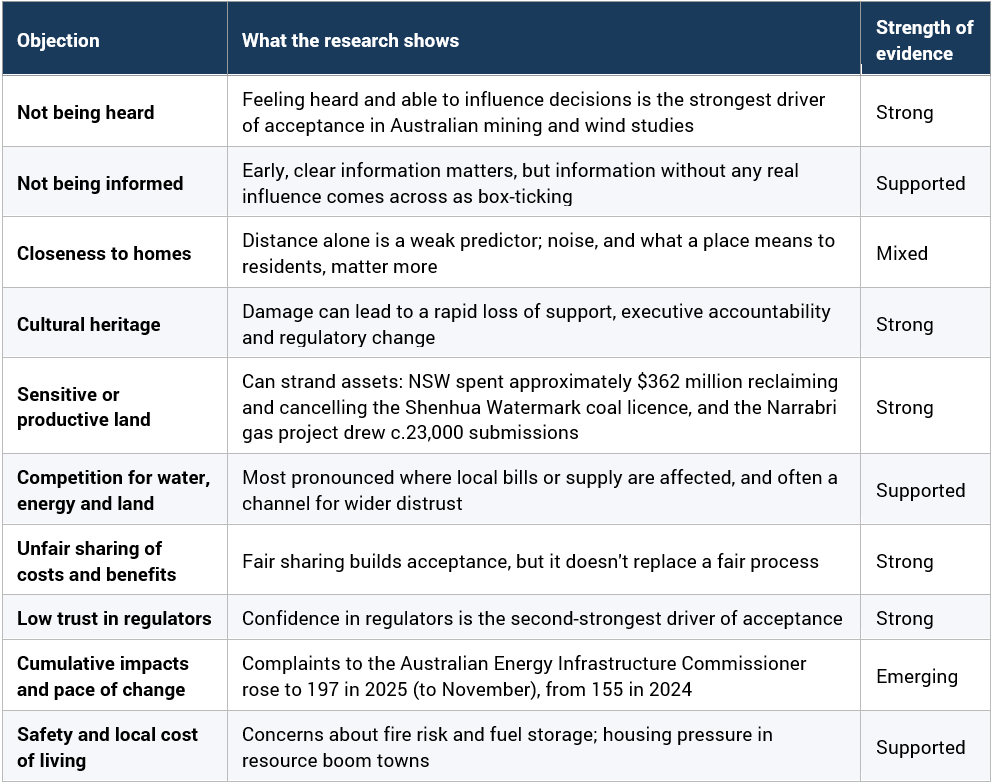
Sources: as listed[15]
How a decision is made often matters more than how close a project is
In CSIRO’s 2024 national survey of more than 6,400 Australians, procedural fairness, which simply means people feeling heard and being able to influence decisions, was the strongest driver of whether they accepted mining. It ranked ahead of confidence in regulators, a sense of local control and a fair share of the benefits. Only 35% felt that people like them got a fair share of mining’s benefits.[16] Separately, a US study of 1,705 people living near wind farms found something similar: a fair process predicted positive attitudes, while living close to turbines or being able to see them did not, although hearing them did.[17] This is part of why researchers have largely moved away from ‘NIMBY’ (not in my backyard) as an explanation. What a place means to people, and how decisions about it are made, tend to matter more than distance alone.[18]
Sharing benefits helps, but it doesn’t replace being heard
Payments offered without a real say tend to fall short. Denmark previously required wind developers to offer 20% of shares to local residents, but an evaluation found the rule didn’t deliver the local acceptance it was designed to, and its abolition was proposed in 2019.[19] Peter Sandman, a risk communication researcher, described the underlying dynamic back in 1987 as ‘hazard plus outrage’.[20] Hazard is the technical risk. Outrage is how people feel about it, and it grows when a risk is imposed rather than chosen, controlled by others, shared unfairly or explained by people they don’t trust. Better engineering can reduce the hazard, but on its own it does little to ease the outrage. That helps explain how a water-efficient data centre can still be opposed for ‘taking our water’.
What good engagement looks like
Decades of research point to a fairly consistent set of principles. One of the most widely used frameworks, developed by Ian Thomson and Robert Boutilier, describes social licence as a series of levels (refer Figure 1).[21] At the bottom, a community withholds or withdraws its consent. Above that sits acceptance, then approval, and at the top a sense of shared ownership, where the community views the project as partly its own. Moving up means first earning legitimacy (following the rules, both formal and local), then credibility (keeping promises and being open), and finally trust. Most projects sit at the acceptance level, which is also the most fragile: the community tolerates the project but watches it closely, and one misstep can tip it back into opposition.
Figure 1. The levels of social licence

Source: Yarra Capital Management, adapted from Thomson and Boutilier (2011).
Australian research helps explain what moves a community up those levels (refer Figure 2). A fair process, confidence that regulators will hold the company to account, a sense of local control and a fair sharing of benefits all build trust, and trust in turn underpins acceptance.[22] In practice, this means moving away from what planners have called ‘decide, announce, defend’ towards ‘engage, interact and co-operate’.[23] It means engaging with communities while options are still open, showing them what changed as a result, and giving them a real hand in shaping the decisions that impact them.
Figure 2. The builders of community acceptance

Source: Yarra Capital Management, drawing on CSIRO Attitudes to Mining Survey (2024; drivers ranked by strength), Moffat and Zhang (2014), Zhang et al. (2015) and Sandman (1987).
Getting this wrong has a real and measurable cost. A 2014 study of 50 resource projects estimated that, for a large mine with US$3–5 billion of capital expenditure, each week of delayed production costs approximately US$20 million in present value terms, and that one nine-month delay in Latin America cost US$750 million.[24] Leadership time was a less visible cost: in some companies, assets representing 10% or less of income took more than 80% of senior management’s time. Often the largest cost was the opportunity lost, in expansions and new projects that never went ahead.[25]
What other sectors have learnt
Mining is often held up as the sector that does community engagement best. We would put it a little differently: it is the sector that has learnt the most, often the hard way. The Panguna mine on Bougainville closed in 1989 amid disputes over land, environmental damage and how benefits were shared, and a decade of conflict followed.25F[26] Newmont’s Conga project in Peru was suspended in 2012 after deadly protests and more than US$1.4 billion of spending.[27] The destruction of the Juukan Gorge rock shelters in 2020, which had legal approval, led to the departure of Rio Tinto’s chief executive and two senior executives, and to a parliamentary inquiry report titled Never Again.[28]
The same sector has also produced some of the most lasting agreements. The Western Cape Communities Co-existence Agreement at Weipa, signed in 2001, brought together Traditional Owner groups, local councils, the Queensland Government and the miner, and directs around $6 million a year into community trusts. Reviews have been open about its governance challenges, and we would argue that willingness to revisit the terms is part of why it has lasted.[29] At Argyle, the participation agreement included a ‘no means no’ principle, although Traditional Owners’ recent concerns about the mine’s closure are a reminder that social licence needs looking after right through to the end of a project’s life.[30] Electricity transmission in Australia is now on a similar learning curve, with major Victorian projects delayed and costs rising as landholder engagement takes longer than planned.[31]
What it means for investors
Social licence risk is difficult to price. It tends to build quietly and then surface suddenly, often through a party other than the company itself, and sometimes over an issue that bears little relation to the project’s actual footprint. We do not believe any investor can reliably predict when and where a flashpoint will occur. What we can do is recognise the conditions that make one more likely, ask companies the right questions early, and weigh how much of the investment case depends on timelines that rest with others.
For Australian investors the exposure is concentrated: our market is weighted towards resources, property and infrastructure, and AI is drawing developers, property trusts, utilities and networks into land- and power-hungry projects located close to where people live.
The same lens applies well beyond data centres. AEMO’s modelling shows that if infrastructure is delivered more slowly, the 2030 renewable targets are not met on schedule, coal plants stay in service longer and more gas is used.31F[32] For investors in networks, utilities, renewable developers and those industries counting on cheaper and cleaner power, social licence is becoming one of the main factors in how quickly – and at what cost – the transition happens. It’s a broader and more complex topic than one paper can cover, and one we expect to return to.
The long-term case, and what could slow it
None of the findings change our view that demand for data centre capacity in Australia has a long runway. AEMO’s 2026 Electricity Statement of Opportunities, which included data centres in its forecasts for the first time, expects their electricity use in the National Electricity Market to grow from around 5 TWh today to around 15 TWh by 2029–30 and 34 TWh by 2035–36, or about 13% of operational consumption.[33] Operators with contracted customers, established sites and strong funding positions are well placed to meet that demand. At M3, NextDC has said the affected capacity remains under contract and construction of the data halls is continuing while it works with its customers and with Jemena to bring power forward. Victoria’s new rules may also help over time, by giving developers and communities clearer expectations on buffers, water use and local investment than case-by-case disputes allow.
The sensitivities are mostly about timing. Grid connections depend on network businesses, councils and communities that operators don’t control. Planning decisions in Victoria are on hold until after the election, and a Senate inquiry and a proposed federal levy add policy uncertainty. Each of these can shift when new capacity comes online, and with it when earnings arrive, even where long-term demand is not in question. That makes the quality of community engagement across a company’s whole delivery chain an increasingly important part of how we think about the sector. We’ll be watching how Victoria applies its new rules after the election and what the Senate inquiry finds.
Signs we look out for (i.e. potential red flags)
- New land- or resource-hungry developments being located near homes, heritage sites, sensitive environments or farmland, such as data centres, transmission, mining, gas and large industrial property.
- Projects that rely on infrastructure the company doesn’t control (e.g. grid connections, road access or water), where a third party’s engagement becomes the company’s risk.
- Rapid or cumulative change in one area, especially where an existing site already has unresolved complaints.
- Benefits that flow out of the region while the costs, such as noise, traffic and higher bills, stay local.
- Little or no reporting on complaints or community sentiment, and no clear oversight by the board.
Key points of discussion with the market
- Who in your delivery chain deals directly with the community, such as contractors, network operators or councils, and how do you oversee engagement you don’t directly control?
- What has the community told you, and what have you changed as a result?
- How are local costs and benefits shared, and how do you know whether the community regards that as fair?
- What metrics do you track (e.g. complaints, resolution times, sentiment), and how often does the board see it?
- If consent were withdrawn at your most sensitive point, what would a delay cost, and what alternatives do you have (e.g. undergrounding, rerouting or redesign)?
Key Takeaways
- Community consent can be the first constraint on land- and resource-intensive growth, from data centres to the transmission lines the energy transition depends on.
- Communities respond most to how they are treated: being heard, kept informed and treated fairly.
- Social licence is shared across a project’s delivery chain, so it pays to understand who holds each relationship.
The histories of Cadbury’s Bournville project and NextDC’s West Footscray facility are almost 150 years apart, yet the question a community asks of a business hasn’t changed much: are we being treated fairly? Technology can answer AI’s energy and water needs far faster than trust can be earned, underscoring why these risks deserve closer attention.
+++
[1] ABC News, ‘Suburban residents protest 15-metre power poles linked to data centre expansion’, 27 September 2026.
[2] NextDC, ‘M3 Melbourne Power Delay & Revised FY27 Guidance’, ASX announcement, 21 October 2026.
[3] ABC News, ‘Fire insiders alarmed over data centre expansion in Melbourne’s inner west’, 9 June 2026.
[4] ABC News, ‘AI data centres probed by Senate inquiry as locals near NextDC facility demand compensation’, 23 September 2026.
[5] AEMO, 2026 Integrated System Plan, 25 June 2026, pp. 18 and 26.
[6] AAP, ‘Major transmission project paused after public outcry’, Canberra Times, 15 September 2026 (cost estimates of $479m in 2019 and $1.53bn in a 2024 PwC document).
[7] Premier of Victoria, ‘We Need Data Centres But We Set The Rules’, 22 September 2026.
[8] Data Center Watch (10a Labs), 2025 report and Q1 2026 update.
[9] Pew Research Center, 22 September 2026 (survey of 10,548 US adults, July–August 2026).
[10] AZ Luminaria, 6 August 2025; KJZZ, 19 September 2025; KOLD, 9 January 2026.
[11] Georgia Public Broadcasting, 13 October 2026. Single secondary source; county decision not verified against council records.
[12] DatacenterDynamics, 16 August 2022, citing Noordhollands Dagblad. We were unable to access the original report.
[13] Vanclay, F. (2026), ‘Who coined the term social licence to operate?’, Impact Assessment and Project Appraisal 44(1): 2–12.
[14] Rowlinson, M., commentary on the Kraft takeover of Cadbury, Queen Mary University of London, 22 January 2010.
[15] Gross (2007), Energy Policy 35(5): 2727–2736; AEIC Review of Community Engagement Practices (2023); AEIC opening statement, Senate Estimates, 1 December 2025; The Land, 21 April 2021; Northern Daily Leader (Narrabri submissions); AHURI Bulletin 120 (2009). Other sources as cited in the text.
[16] CSIRO, Attitudes to Mining Survey 2024 (n=6,448).
[17] Hoen, B. et al. (2019), Energy Policy 134: 110981.
[18] Bell, Gray and Haggett (2005), Environmental Politics 14(4): 460–477; Devine-Wright (2009), Journal of Community & Applied Social Psychology 19(6): 426–441.
[19] AURES II, Denmark case study (DTU); Danish Parliament, KEF Alm.del bilag 113, December 2019. Final repeal date not verified.
[20] Sandman, P. (1987), ‘Risk Communication: Facing Public Outrage’, EPA Journal, November: 21–22.
[21] Thomson, I. and Boutilier, R. (2011), ‘Social License to Operate’, SME Mining Engineering Handbook, ch. 17.2.
[22] Moffat and Zhang (2014), Resources Policy 39: 61–70; Zhang et al. (2015), Journal of Cleaner Production 108: 1063–1072; CSIRO (2024).
[23] OECD Nuclear Energy Agency, Forum on Stakeholder Confidence, NEA/RWM/FSC(2004)6/REV1.
[24] Franks, D. et al. (2014), ‘Conflict translates environmental and social risk into business costs’, PNAS 111(21): 7576–7581.
[25] Davis, R. and Franks, D. (2014), ‘Costs of Company-Community Conflict in the Extractive Sector’, Harvard Kennedy School CSR Initiative Report No. 66.
[26] O’Callaghan, M. (2002), ‘The origins of the conflict’, Accord 12, Conciliation Resources.
[27] Davis and Franks (2014); Newmont Mining Corporation, Form 10-K for FY2016.
[28] Parliament of Australia, ‘Never Again (December 2020)’; PKKP and Rio Tinto co-management agreement, 1 June 2025.
[29] Keenan, J. and Ramsay, D. (2013), Mining and Local-Level Development: Rio Tinto Alcan Weipa, CSRM, University of Queensland.
[30] National Indigenous Times, 12 December 2025.
[31] ESD News on VNI West timing and costs; Premier of Victoria, statement on the Western Renewables Link, 15 September 2026.
[32] AEMO, 2026 Integrated System Plan, p. 26.
[33] AEMO, 2026 Electricity Statement of Opportunities (Step Change scenario), as reported by W.Media, 25 August 2026.



0 Comments