


For the better part of two decades, Australian equity investors have been rewarded primarily through capital growth. Falling interest rates, supportive tax settings and a long-running preference for growth assets pushed income further down the priority list.
That backdrop is changing. Proposed CGT reforms are likely to reduce the relative attractiveness of capital gains, while demographic trends are increasing demand for reliable income streams. At the same time, payout ratios remain below long-term averages, franking credit balances are elevated across parts of the market, and consensus earnings expectations appear vulnerable in several sectors.
Together, these forces suggest the Australian market may be returning to its traditional roots as an income market. The question for investors is not simply where to find yield, but where to find sustainable income that can grow through the cycle.
In this note, we outline four reasons why the outlook for equity income has improved materially and why active income selection is likely to matter more in the years ahead.
1. The pendulum is swinging back to income
For much of the 20th century, Australia was an income market: yields averaged around 6.5%, with capital growth the quieter contributor.
From the late 1980s the pendulum swung to growth: imputation (1987) brought new demand for franked-dividends, while the CGT discount (1999) turbocharged long-term gains. Yields fell to 3–4% and capital growth came to dominate (refer Fig 1).
Fig 1. ASX 200 historical perspective on income and capital returns

Source: YCM, ASX, Aug 2026.
May’s Federal Budget CGT proposal is a “Back to the Future” moment. From July 2027 the 50% discount will be scraped, a 30% minimum tax on gains introduced and the cost base indexed to inflation.
The implication is straightforward: if the reward for capital-gains falls, retail investors (40% of the ASX) will place higher value on cash income. Under the old CGT 50% discount regime, income was 48% of total returns. Over the preceding 110 years to 2000, it was 56%. Moving forward, income could certainly reclaim more than half of the return equation.
2. CGT reform will reshape investor priorities
Payout ratios today are at 15-year lows (60% vs a 66% long-run average) (refer Fig 2), with CGT reform now likely to encourage firms to lift payouts to boost after-tax returns.
Fig 2. Historical aggregate ASX 200 payout ratio

Source: YCM, Goldman Sachs Investment Research, FactSet, Jun-2026.
We expect this will resonate strongly with large cohorts of investors who have been heavily exposed by the recent volatility in returns of ‘growth’ strategies. Further, large surplus franking credit balances across a number of ASX companies point to fully franked special dividends featuring ahead.
This collides with a demographic cliff — lower birth rates and a doubling of retirees to ~300k a year over the next decade — lifting demand for sustainable income as tax changes push the market to raise after-tax yields.
3. Not all income is created equal (why stock selection matters)
The market enters FY27 with a fragile earnings base and too much optimism in consensus considering growth is slowing, funding costs are high, and inflation is grinding margins. ASX 200 consensus growth of ~9% — about twice the long-run rate — looks heroic.
We expect growth of nearer 5%, dragged down by risks that are concentrated in large, index-heavy sectors (refer Fig 3):
-
- Banks: consensus suggests ~5% growth, but softer loan growth, margin pressure and rising bad debts could turn it negative in FY27.
- Healthcare: large US-exposed names (e.g. CSL, Cochlear) face slower top-line momentum on affordability and regulatory issues.
- REITs: higher borrowing costs are pressuring FFO, with base rates higher since last reporting season (approximately +50bps for both BBSW and two-year swap).
Fig 3. Sectors where FY27 consensus earnings risk look most exposed

Source: YCM, Goldman Sachs Investment Research, FactSet, Aug 2026.
These factors matter for income investors with softer earnings typically begetting softer dividends. Consensus has the big four banks driving a whopping 30% of aggregate ASX 200 gross income, well above their 24% capitalisation weight. If bank dividends disappoint, a passive income approach is over-exposed to the downside.
4. The highest yields are rarely the best investments
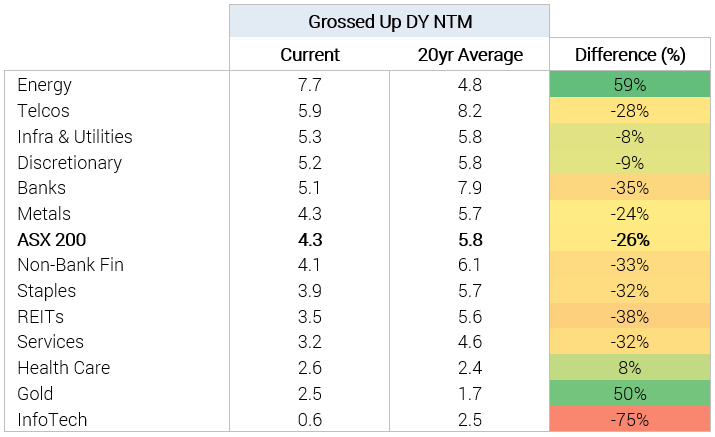
The temptation is obvious: buy the biggest yield and move on — usually a mistake. Grossed-up yields span ~8% in energy to under 1% in IT, but the prize is a dividend that can be sustained and grown without eroding capital.
Fig 4. Prospective consensus dividend yields by sector (grossed up for franking)
Source: YCM, Goldman Sachs Investment Research, FactSet, Aug 2026.
Our equity income strategy starts with after-tax total return, not yield alone. We are deliberately balanced — overweight selected higher-yielding sectors where income looks durable, and lower-yielding sectors where dividend growth does the heavy lifting.
Higher-yielding sectors where we see attractive income:
-
- Energy: Woodside (quality assets, supportive LNG, potential sell-downs).
- Telcos: TPG Telecom and Telstra (supportive industry structure, non-discretionary demand).
- Utilities: Origin Energy (low embedded expectations, room for upside).
Lower-yielding sectors where we see dividend growth potential:
-
- Metals and mining: Rio Tinto and Evolution Mining — include advantaged copper exposures with capital management opportunities.
- Online classifieds: CAR and SEEK — marked down on AI fears despite strong products.
- Consumer staples: Coles — preferred supermarket exposure, dividend-surprise candidate.
Avoiding dividend traps is central to our approach. Our proprietary Ten-Factor Dividend Predictive Tool flags dividend surprises early and enables us to avoid or cut exposures to high yields that are vulnerable to price correction Endeavour and AGL Energy are currently showing warning signs.
History is a blunt reminder: the best returns come from combining solid, compounding income with growth (i.e. the 2nd to 5th dividend deciles) (refer Fig 5) with some exposure to quality growth cohorts (i.e. 9th dividend decile). The highest-yielding decile has lost ~3% p.a. on average in capital. A big yield can be a warning light, not a bargain.
Fig 5. ASX 200 historical return composition (average, last 20 years)

Source: YCM, Goldman Sachs Investment Research, FactSet, Jun-Aug 2026.
Clearly the ASX is heading back towards an income market just as investors need income most. CGT reform, low payouts, surplus franking, demographic demand and more reasonable valuations all point one way. With a style-neutral process and a target franked yield more than 2% above the ASX 200 (above 6.0% p.a.), our equity income strategy is well-placed for this coming phase.


0 Comments